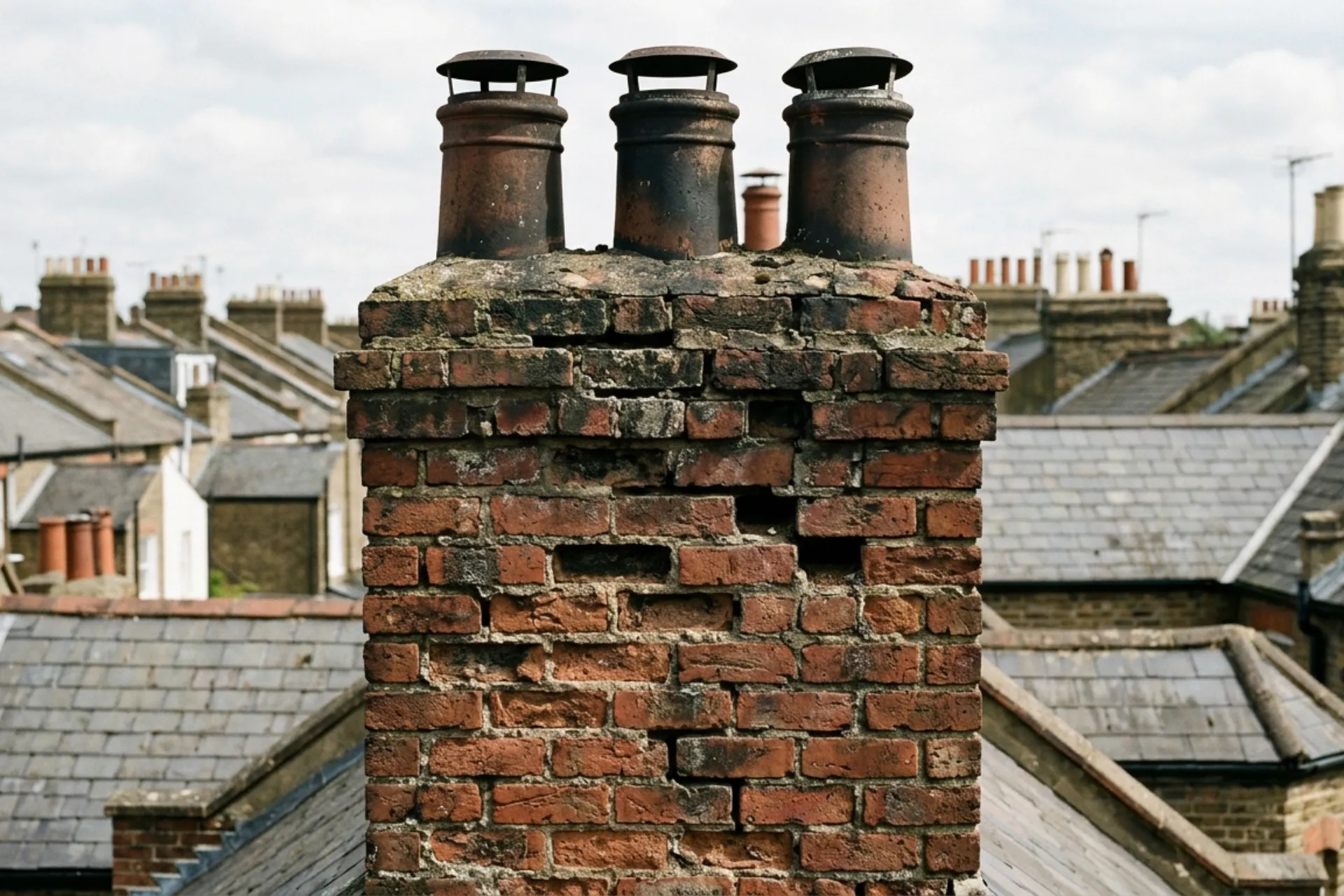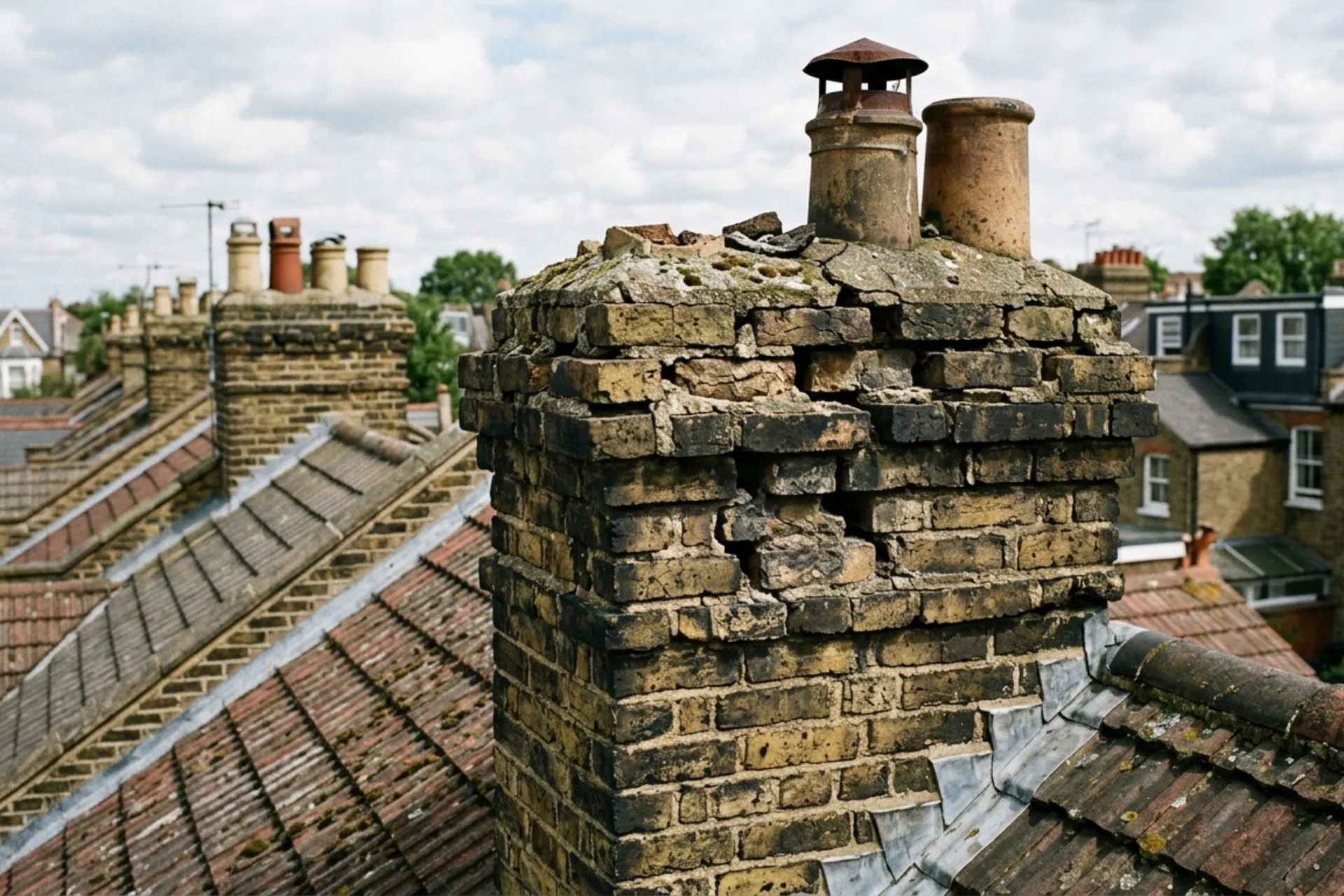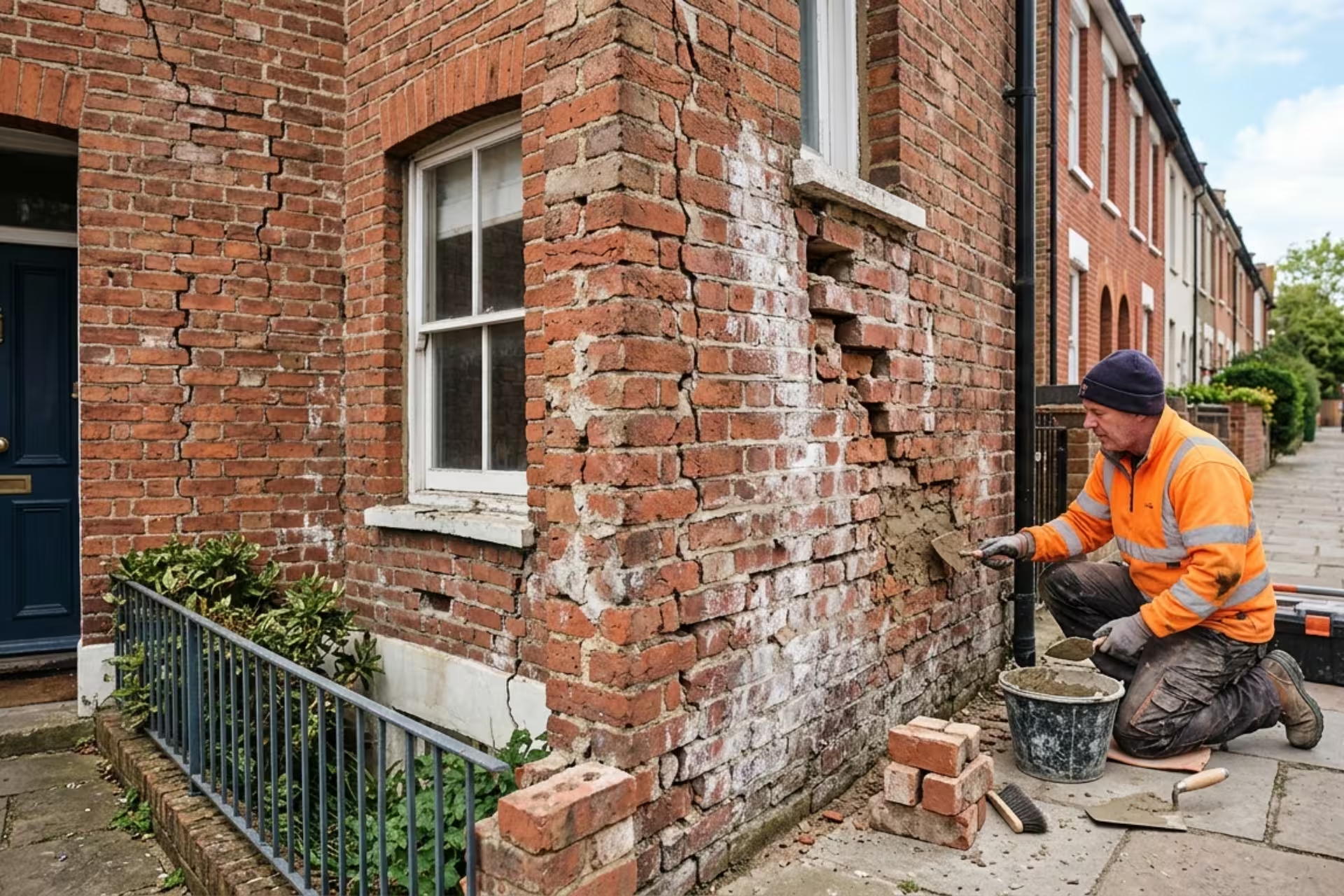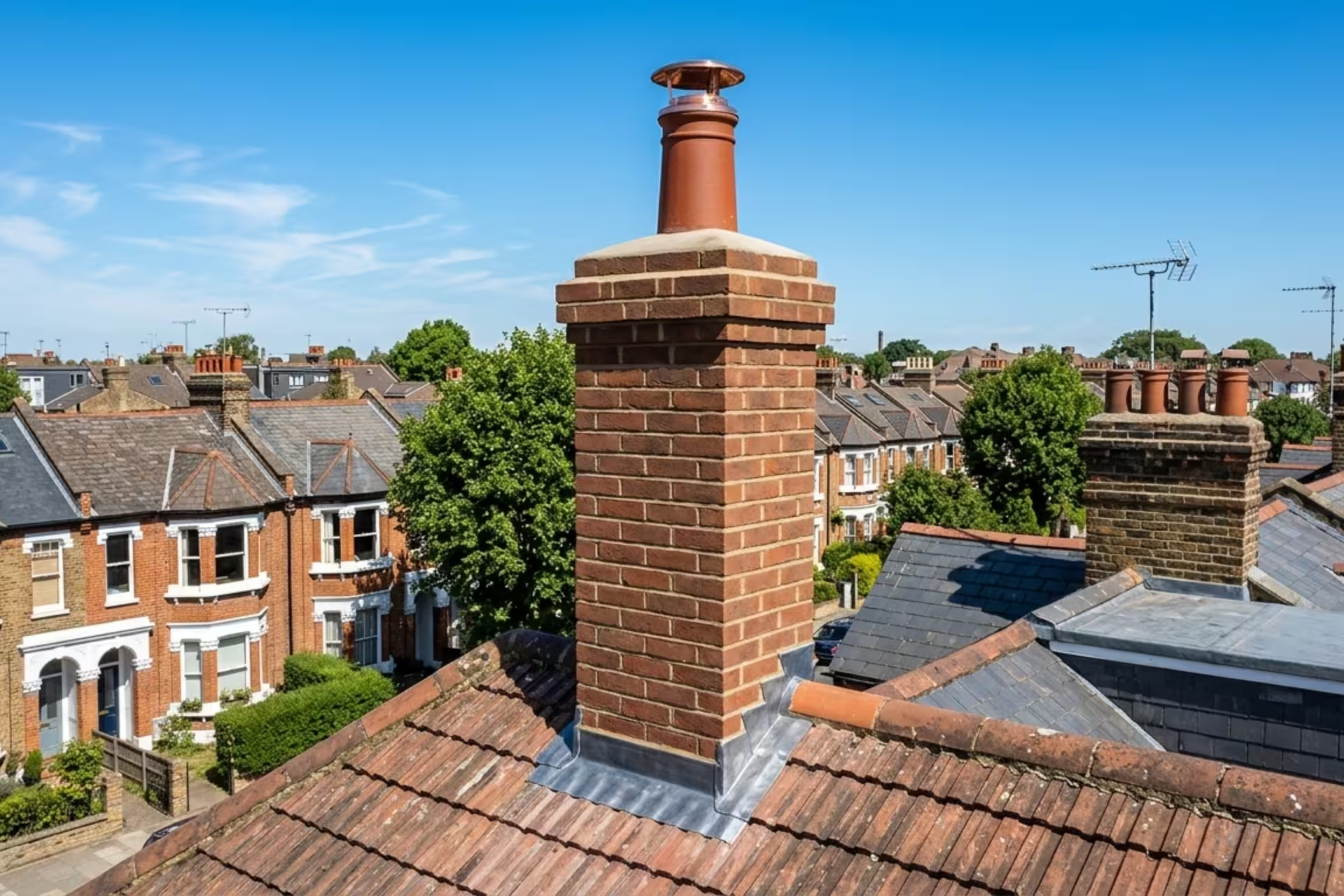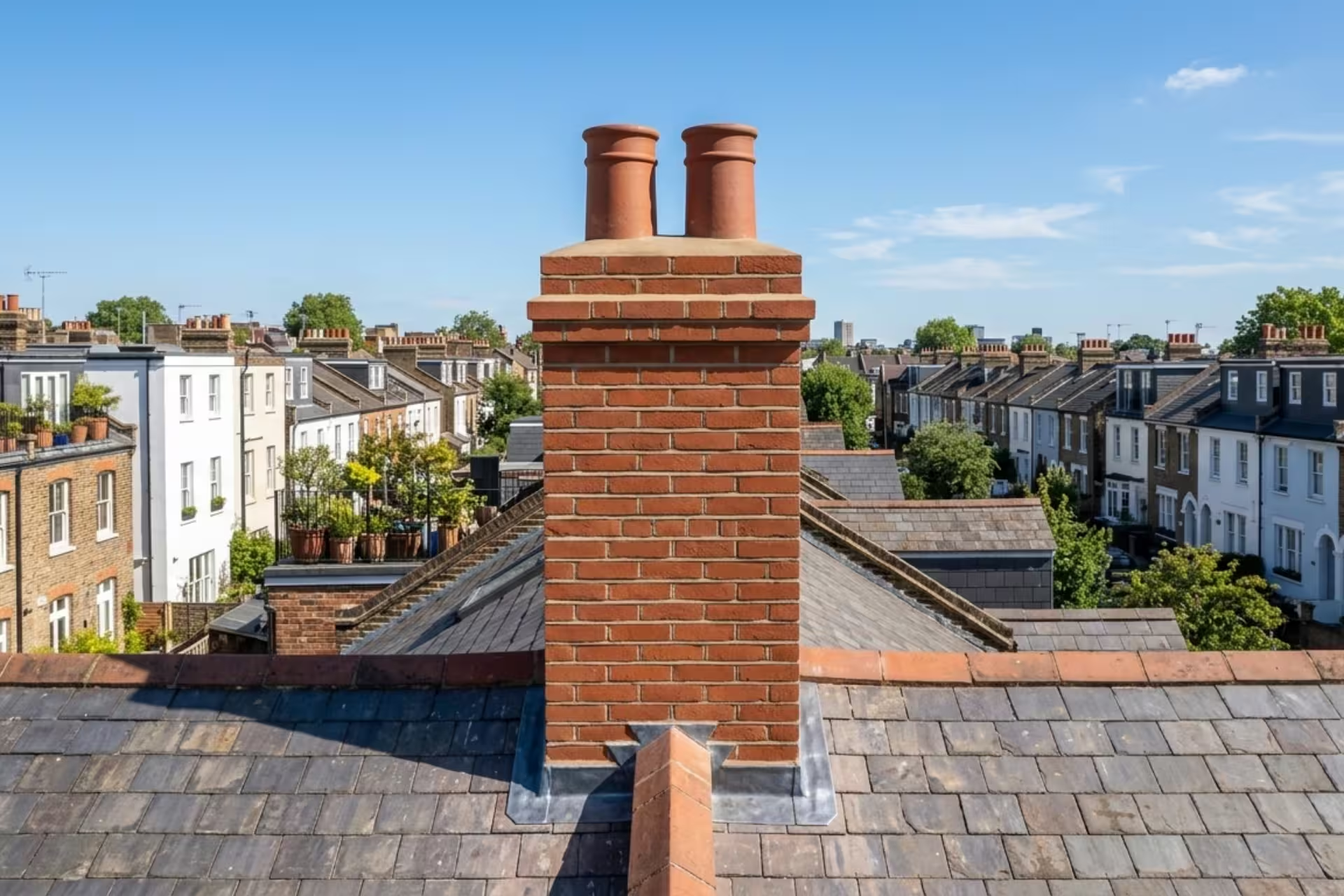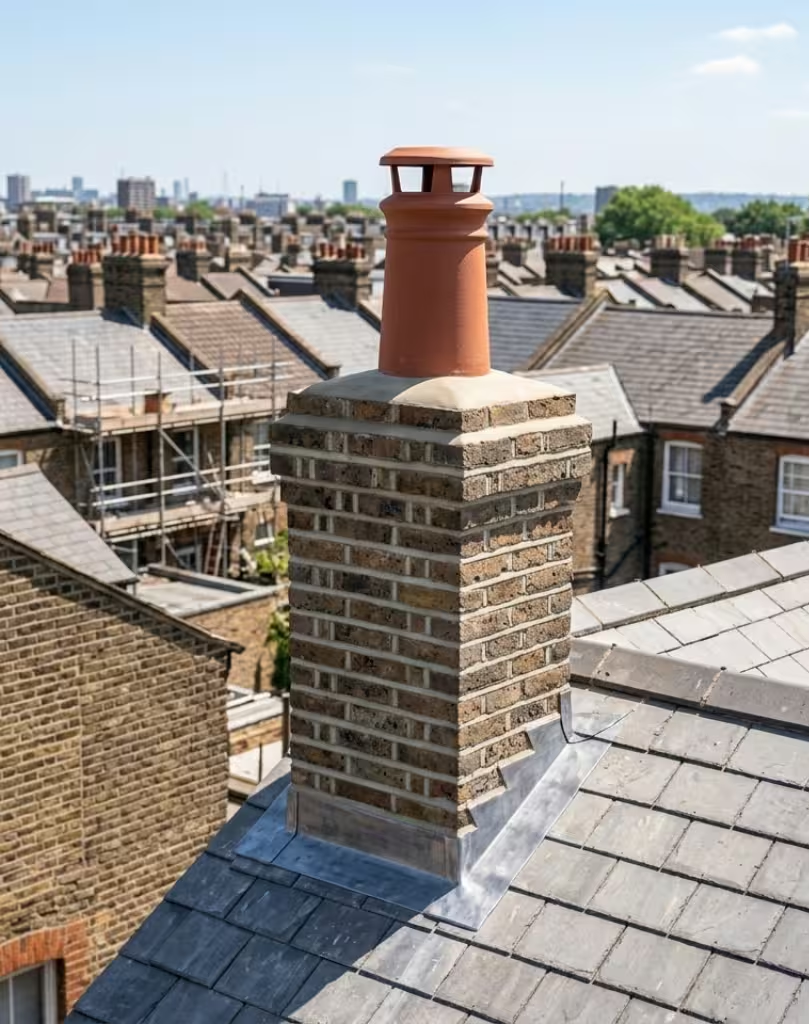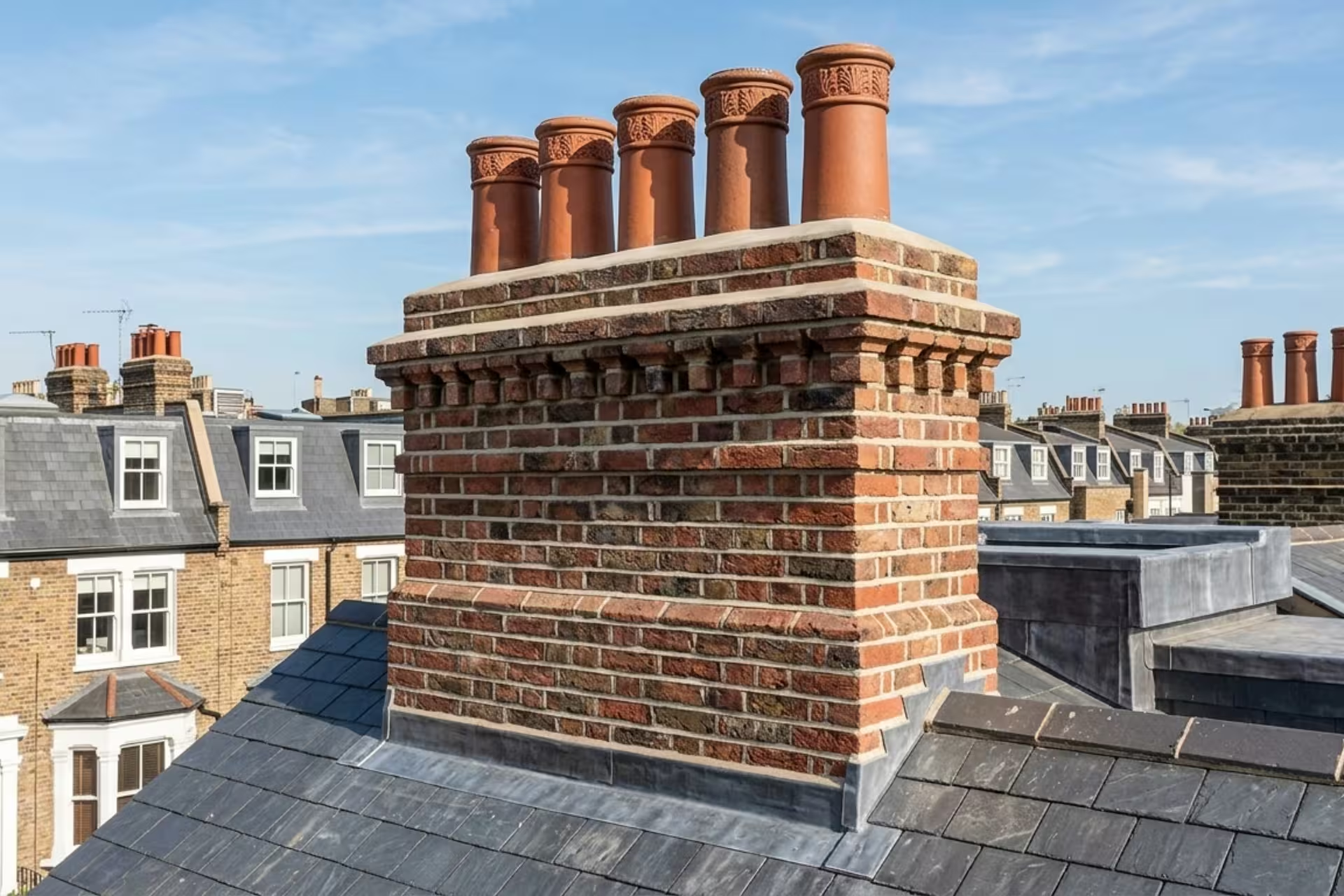
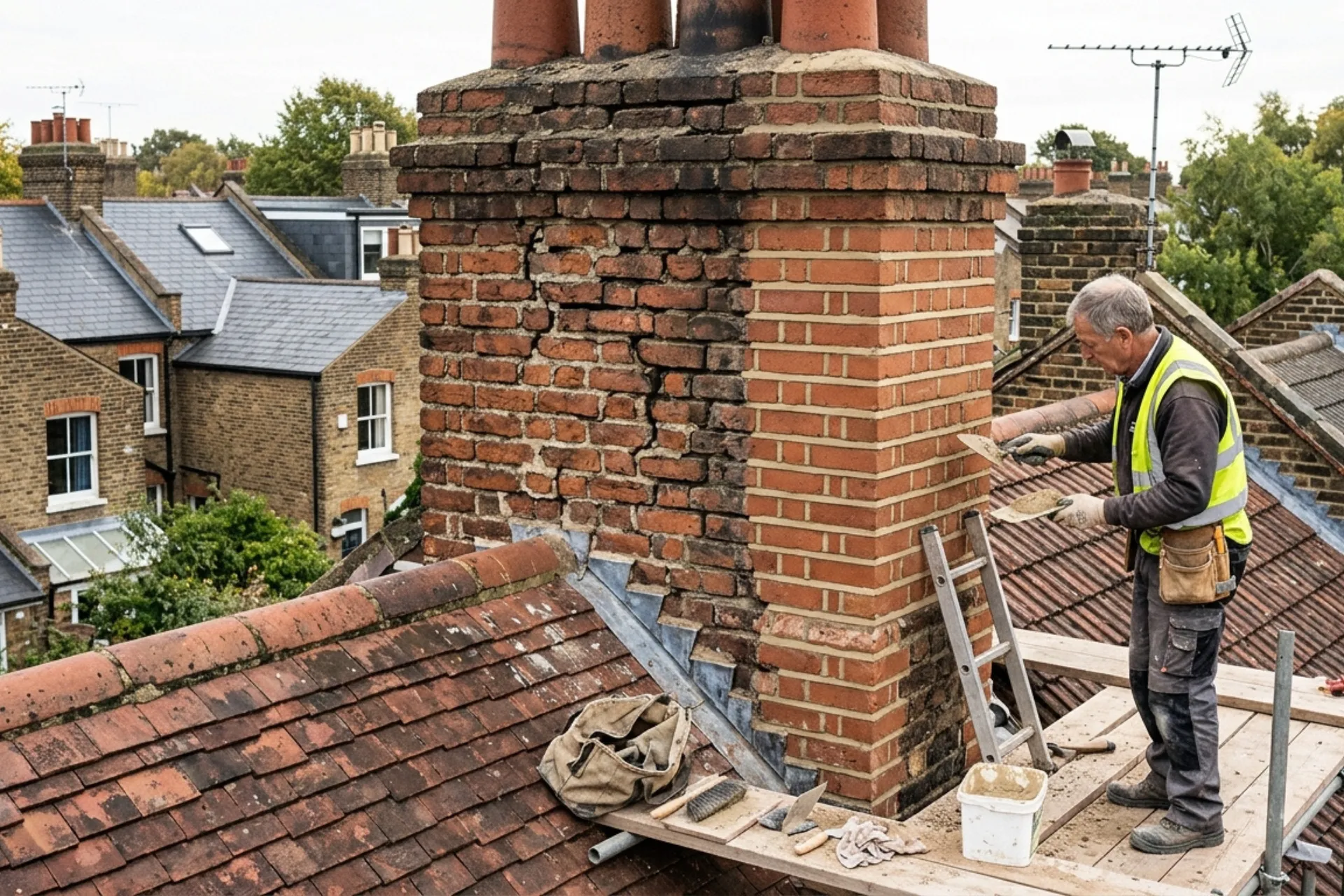
If the mortar between your chimney bricks has started crumbling, cracking or falling away, one of your first questions is likely to be: How much will it cost to repoint the chimney?
Chimney repointing costs in London vary depending on the size of the stack, the condition of the existing mortar, how easily the chimney can be accessed and whether any additional brickwork repairs are required.
As a general UK guide, a small, easily accessible chimney may cost around £300 to repoint, while more involved projects commonly fall between £500 and £1,000. Difficult access, scaffolding requirements or extensive masonry repairs can push the total higher.
These are indicative industry figures rather than fixed prices. A reliable quotation should reflect the actual condition of your chimney and the work needed to restore it.
In this guide, we’ll explain what influences chimney repointing prices in London, how different repair scopes affect the cost and what to check before choosing a contractor.
What Is the Average Cost of Chimney Repointing in London?
Published UK cost guides suggest that chimney repointing typically averages around £750, although individual quotations can be significantly lower or higher.
A straightforward job on a small, accessible stack may require less labour and simpler access arrangements than a tall chimney in the middle of a pitched roof.
For London properties, the total can also be influenced by restricted site access, scaffolding arrangements and the complexity of working on older buildings.
The following estimates offer a starting point for budgeting.
| Type of chimney repointing work | Indicative price |
|---|---|
| Small chimney with straightforward access | Around £300 |
| Standard chimney repointing project | Around £500–£1,000 |
| Chimney requiring more complex roof access | Around £800–£1,500 |
| Extensive repointing with difficult access | May exceed £1,500 |
These figures are broad UK budgeting estimates, not guaranteed London prices or quotations from MR Chimney Repairs. The final cost depends on inspection findings, access requirements and the agreed scope of work.
The size of the chimney alone does not determine the price. Two properties with similar-looking chimney stacks may receive different quotations because the access and underlying repairs are different.
What Affects the Cost of Chimney Repointing?
Several practical factors determine how much a contractor may charge to repoint a chimney.
Understanding them helps you compare quotations more accurately.
1. Chimney Height and Overall Size
Larger chimney stacks have more mortar joints to assess, prepare and repoint.
A compact chimney above a single-storey extension may require considerably less work than a substantial brick stack extending above a two- or three-storey property.
The height of the building also matters because it influences how workers and materials can safely reach the chimney.
How this affects your quote: Larger or taller stacks can increase labour time, materials and access costs.
2. Scaffolding and Safe Roof Access
Access is often one of the most significant variables in chimney repointing costs.
Chimneys sit above roof level, and contractors need a suitable working position to remove defective mortar and apply replacement material correctly.
Depending on the building, the work may require scaffolding, a specialist working platform or another appropriate access arrangement.
For example, a chimney positioned near the edge of an accessible roof may present different challenges from a central chimney above a steep roof pitch.
In London, narrow side passages, rear extensions, neighbouring properties and restricted space can also complicate access.
How this affects your quote: More extensive access arrangements can increase the cost even when the chimney itself is relatively small.
3. How Much Mortar Needs Replacing
Not every chimney requires all its joints to be repointed.
Some stacks have a small area of failed mortar, while others show deep erosion across several exposed faces.
The contractor must assess whether the deterioration is limited to specific joints or is more widespread.
Repointing a few affected areas generally involves a different workload from preparing and repointing an entire chimney stack.
However, even a small repair may require significant access arrangements.
How this affects your quote: The amount and depth of defective mortar influence the time required, but access costs may still represent a substantial part of a small job.
4. Condition of the Existing Chimney Bricks
Mortar deterioration sometimes occurs alongside damaged or loose bricks.
If individual bricks are cracked, spalled or unstable, replacing the mortar alone may not resolve the problem.
Additional brickwork repairs could include carefully removing defective bricks, sourcing suitable replacements and restoring affected masonry.
These tasks should be assessed and priced separately where possible.
How this affects your quote: Brick replacement and additional masonry work can increase material requirements and labour costs.
5. Type of Mortar Required
The mortar used for repointing should be compatible with the existing brickwork.
Some older London properties were constructed using lime-based mortar and relatively soft bricks. Such masonry may require a different approach from modern brickwork.
Selecting suitable mortar is not simply a matter of choosing the hardest available mix.
The contractor should consider the age of the building, the original materials, exposure conditions and the condition of the brickwork.
How this affects your quote: Mortar specification, preparation and appropriate curing arrangements may affect the overall price and programme.
6. Existing Damage Around the Chimney Top
Repointing focuses on the joints between bricks, but other parts of the chimney may also require attention.
For example, deteriorated flaunching around chimney pots, cracked upper brick courses or defective chimney-top components may need separate repairs.
A chimney with several defects can require a broader scope of work than pointing alone.
How this affects your quote: Additional work should be clearly identified rather than assumed to be part of the basic repointing price.
7. Property Layout and Accessibility
London properties vary considerably in design.
A terraced house with limited rear access may be more challenging than a property with open space around the building.
Other considerations include conservatories, rear extensions, neighbouring boundaries, roof pitch and safe delivery or installation of access equipment.
These conditions may affect the practical arrangements needed to complete the work.
How this affects your quote: Restricted access can increase preparation time, equipment requirements and overall complexity.
Partial Chimney Repointing vs Full Chimney Repointing: Which Costs More?
One important distinction is whether the chimney requires localised joint repairs or widespread repointing.
Partial Chimney Repointing
Partial repointing focuses on selected sections where mortar has deteriorated.
It may be appropriate when the damage is restricted to a relatively small area and the remaining joints are sound.
Because less mortar needs replacing, the masonry work may cost less.
However, access equipment may still be required, which can make the overall saving smaller than homeowners expect.
Full Chimney Stack Repointing
Full repointing involves repairing defective joints across the relevant exposed faces of the chimney stack.
It is more extensive and normally requires additional labour.
Where deterioration is widespread, treating the affected stack comprehensively may be more suitable than repeatedly returning for isolated repairs.
Which Offers Better Value?
The lowest initial cost is not always the most economical long-term solution.
If most of the mortar remains sound, targeted repointing may be entirely appropriate.
If deterioration is widespread, a larger repair programme may reduce the likelihood of repeated access and repair costs.
The best option depends on the condition of the joints, surrounding brickwork and overall chimney stability.
Why Scaffolding Can Make Up a Significant Part of the Cost
Homeowners are sometimes surprised when a relatively small mortar repair requires a more substantial quotation than expected.
A major reason is safe access.
Even if only a limited section requires repointing, workers must be able to reach and work on the chimney safely.
Scaffolding and other access systems may involve installation, inspection, hire and dismantling.
The work may also require arrangements to protect roof surfaces and areas below the chimney.
This means a job should not be judged only by how many bricks or mortar joints are visibly damaged.
When comparing quotations, ask whether access equipment is included and what type of arrangement has been allowed for.
A cheaper quotation that excludes essential access costs may not represent a lower final price.
What Should Be Included in a Chimney Repointing Quote?
A clear written quotation helps homeowners understand exactly what they are paying for.
Before accepting an estimate, check whether it identifies the following:
- Scope of repointing: Which chimney faces or areas will be repaired?
- Mortar preparation: Will defective existing mortar be removed to a suitable depth?
- Replacement materials: What mortar type will be used, and why is it appropriate?
- Scaffolding or access: Is the required access equipment included?
- Brick repairs: Are damaged bricks included or priced separately?
- Additional chimney work: Are flaunching, chimney pots or other defects part of the quotation?
- Site protection: What arrangements will be made to protect nearby roof surfaces and property?
- Waste removal: Is clearing away debris included?
- Timing: What is the expected work schedule, subject to suitable weather and access?
- Total cost: Is VAT included, where applicable, and how will unforeseen work be handled?
The quotation should also explain whether the price is fixed for the agreed scope or subject to specified conditions.
Understanding these details makes it easier to compare contractors on a like-for-like basis.
Why Two Chimney Repointing Quotes May Be Very Different
Receiving different prices for apparently similar chimney work does not automatically mean one contractor is overcharging.
There may be differences in what each contractor has included.
One quotation might cover only the visibly deteriorated joints, while another may allow for a wider area of masonry.
Similarly, one price might include scaffolding, waste removal and replacement bricks, while another lists these as additional costs.
Differences may also arise from the mortar specification and proposed method of work.
The most useful comparison is therefore between the actual work descriptions rather than simply the final totals.
Before deciding, ask each contractor to explain any major differences in the proposed scope.
Can You Save Money by Repointing Only the Damaged Side?
In some cases, yes.
If mortar deterioration is genuinely limited to one chimney face and the remaining joints are in good condition, repairing that section may be sensible.
However, the stack should be examined as a whole before the scope is agreed.
A damaged section may be visible from the street while deterioration on the opposite face goes unnoticed.
The access arrangement is another consideration. If scaffolding is already required, addressing other necessary repairs during the same visit may avoid the cost of arranging access again.
That does not mean every sound mortar joint needs replacing.
The aim should be to carry out the work that is necessary, using an approach suited to the condition of the masonry.
When Is Repointing Not Enough?
Repointing is intended to restore defective mortar joints.
It cannot, by itself, resolve every chimney problem.
If the chimney has extensive brick deterioration, significant displacement or structural instability, additional repairs may be necessary.
Examples include:
- Several rows of bricks have become loose or unstable.
- Large cracks extend through bricks as well as mortar joints.
- The upper chimney stack has suffered extensive deterioration.
- Significant movement or leaning requires investigation.
- Previous repairs have failed because the underlying defect was not resolved.
In these circumstances, partial rebuilding or another form of structural masonry repair may be more appropriate.
You can read our guide to chimney repair versus chimney rebuilding to understand how the two approaches differ.
Is It Cheaper to Repoint a Chimney Before the Damage Gets Worse?
Early attention can sometimes help limit the extent of repairs needed.
When deterioration is confined to the mortar joints and the bricks remain sound, repointing may be a suitable repair.
If moisture continues to enter the masonry or loose joints are left untreated, neighbouring bricks may deteriorate and additional work could become necessary.
However, the urgency depends on the actual condition of the chimney.
A small weathered area may not require immediate major repairs, while loose bricks or significant movement deserve prompt professional attention.
A condition-based assessment is more useful than automatically assuming every older chimney needs complete repointing.
Chimney Repointing Costs for Older London Properties
London has a wide variety of traditional and modern housing, including Victorian terraces, Edwardian houses, converted properties and more recent developments.
Older chimney stacks may contain materials and construction details that require particular care.
For example, removing unsuitable hard pointing from softer historic bricks can require careful workmanship to avoid damaging the brick edges.
Traditional mortar selection and repair detailing may also need additional consideration.
In parts of North London such as Cricklewood, Hampstead, Finchley, Hendon, Willesden and West Hampstead, the condition and construction of individual chimney stacks can vary considerably, even between neighbouring properties.
A quotation should therefore be based on the particular chimney rather than relying solely on the property type or postcode.
Questions to Ask Before Hiring a Chimney Repointing Contractor
Before agreeing to the work, consider asking these questions.
Have You Inspected the Entire Chimney Stack?
A quotation based only on one visible face may miss defects elsewhere.
Ask what has been examined and whether any areas were inaccessible during the initial assessment.
Will You Repoint the Whole Chimney or Only the Defective Joints?
The proposed scope should be clear.
There is an important cost difference between localised joint repairs and comprehensive repointing.
Is Scaffolding Included in the Price?
Ask what access equipment has been allowed for, whether it is included in the total and whether any additional access charges are possible.
How Will You Choose the Replacement Mortar?
The mortar should be appropriate for the existing masonry.
This question is especially important for older properties containing softer bricks or traditional mortar.
What Happens if More Damage Is Found?
Ask how unexpected defects will be documented, priced and approved before additional work begins.
Will the Quotation Be Provided in Writing?
A written description of the agreed work protects both the homeowner and the contractor from misunderstandings about what is included.
Can Chimney Repointing Be Combined With Other Repairs?
Sometimes, combining necessary repairs can be practical, particularly when suitable access equipment is already in place.
For example, a chimney assessment may identify deteriorated mortar alongside a small number of damaged bricks or defective flaunching.
Carrying out approved repairs during the same project may reduce repeated access arrangements.
However, unrelated work should not be added simply because scaffolding is present.
Each additional repair should have a clear purpose and an agreed cost.
If the surrounding roof or flashing also requires specialist attention, the appropriate trades should be involved.
Request a Chimney Repointing Quote in North London
If you’re concerned about loose mortar, gaps between chimney bricks or deterioration around your chimney stack, understanding the condition of the structure is the first step towards getting an accurate repair price.
MR Chimney Repairs is a family-run chimney and brickwork company based in Cricklewood, North London.
Led by Michael Rock, with more than 35 years of personal experience in brickwork, pointing and chimney services, the company provides chimney repointing and related masonry repairs for traditional and modern properties.
We serve homeowners across Cricklewood, Hampstead, Finchley, Hendon, Highgate, Golders Green, Willesden, West Hampstead and nearby North London areas.
Whether your chimney needs localised mortar repairs or more extensive repointing, contact us to discuss the problem and request a quotation based on your property’s condition.
Get a Chimney Repointing Quote
Call: 07751 362934
Email: info@mrchimneyrepairs.co.uk
Explore our chimney repointing services or get in touch to arrange an assessment.